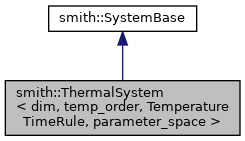
Container for a thermal system with configurable time integration. More...
#include <thermal_system.hpp>
Public Types | |
| using | ThermalWeakFormType = TimeDiscretizedWeakForm< dim, H1< temp_order >, TimeRuleParams< TemperatureTimeRule, H1< temp_order >, parameter_space... > > |
| using for ThermalWeakFormType | |
Public Member Functions | |
| std::vector< FieldState > | getStateFields () const |
| Get the list of all state fields (temperature_solve_state, temperature). More... | |
| std::vector< FieldState > | getOutputFieldStates () const |
| Get the list of physical, non-solve state fields. More... | |
| std::vector< ReactionInfo > | getReactionInfos () const |
| Get information about reaction fields for this system. More... | |
| std::unique_ptr< DifferentiablePhysics > | createDifferentiablePhysics (std::string physics_name) |
| Create a DifferentiablePhysics object for this system. More... | |
| template<typename MaterialType > | |
| void | setMaterial (const MaterialType &material, const std::string &domain_name) |
| Set the thermal material model for a domain. More... | |
| template<int... active_parameters, typename HeatSourceType > | |
| void | addHeatSource (DependsOn< active_parameters... > depends_on, const std::string &domain_name, HeatSourceType source_function) |
| Add a body heat source to the thermal system (with DependsOn). More... | |
| template<typename HeatSourceType > | |
| void | addHeatSource (const std::string &domain_name, HeatSourceType source_function) |
| Add a body heat source that depends on all state and parameter fields. More... | |
| template<int... active_parameters, typename HeatFluxType > | |
| void | addHeatFlux (DependsOn< active_parameters... > depends_on, const std::string &boundary_name, HeatFluxType flux_function) |
| Add a boundary heat flux to the thermal system (with DependsOn). More... | |
| template<typename HeatFluxType > | |
| void | addHeatFlux (const std::string &boundary_name, HeatFluxType flux_function) |
| Add a boundary heat flux that depends on all state and parameter fields. More... | |
 Public Member Functions inherited from smith::SystemBase Public Member Functions inherited from smith::SystemBase | |
| const std::vector< FieldState > & | getParameterFields () const |
| Get the list of all parameter fields. More... | |
| std::string | prefix (const std::string &name) const |
| Helper function to prepend the physics name to a string. More... | |
| std::vector< ReactionInfo > | getReactionInfos () const |
| Metadata for dual outputs exported by this system. | |
Public Attributes | |
| std::shared_ptr< ThermalWeakFormType > | thermal_weak_form |
| Thermal weak form. | |
| std::shared_ptr< DirichletBoundaryConditions > | temperature_bc |
| Temperature boundary conditions. | |
| std::shared_ptr< TemperatureTimeRule > | temperature_time_rule |
| Time integration for temperature. | |
| Public Attributes inherited from smith::SystemBase | |
| std::shared_ptr< FieldStore > | field_store |
| Field store managing the system's fields. | |
| std::shared_ptr< CoupledSystemSolver > | solver |
| The solver for the system. | |
| std::shared_ptr< StateAdvancer > | advancer |
| The state advancer. | |
| std::vector< FieldState > | parameter_fields |
| Optional parameter fields. | |
| std::string | prepend_name |
| Optional prepended name for all fields. | |
Detailed Description
template<int dim, int temp_order, typename TemperatureTimeRule = QuasiStaticFirstOrderTimeIntegrationRule, typename... parameter_space>
struct smith::ThermalSystem< dim, temp_order, TemperatureTimeRule, parameter_space >
Container for a thermal system with configurable time integration.
Always uses a 2-state field layout (temperature_solve_state, temperature). Use QuasiStaticFirstOrderTimeIntegrationRule for steady-state problems, or BackwardEulerFirstOrderTimeIntegrationRule for transient problems.
- Template Parameters
-
dim Spatial dimension. temp_order Order of the temperature basis. TemperatureTimeRule Time integration rule type (must have num_states == 2). parameter_space Finite element spaces for optional parameters.
Definition at line 40 of file thermal_system.hpp.
Member Function Documentation
◆ addHeatFlux() [1/2]
|
inline |
Add a boundary heat flux that depends on all state and parameter fields.
- Parameters
-
boundary_name The name of the boundary where the heat flux is applied. flux_function (t, X, n, T, params...) -> heat_flux.
Definition at line 170 of file thermal_system.hpp.
◆ addHeatFlux() [2/2]
|
inline |
Add a boundary heat flux to the thermal system (with DependsOn).
- Parameters
-
depends_on Selects which primal and parameter fields the contribution depends on. boundary_name The name of the boundary where the heat flux is applied. flux_function (t, X, n, T, params...) -> heat_flux.
Definition at line 151 of file thermal_system.hpp.
◆ addHeatSource() [1/2]
|
inline |
Add a body heat source that depends on all state and parameter fields.
- Parameters
-
domain_name The name of the domain where the heat source is applied. source_function (t, X, T, params...) -> heat_source.
Definition at line 139 of file thermal_system.hpp.
◆ addHeatSource() [2/2]
|
inline |
Add a body heat source to the thermal system (with DependsOn).
- Parameters
-
depends_on Selects which primal and parameter fields the contribution depends on. domain_name The name of the domain where the heat source is applied. source_function (t, X, T, params...) -> heat_source.
Definition at line 121 of file thermal_system.hpp.
◆ createDifferentiablePhysics()
|
inline |
Create a DifferentiablePhysics object for this system.
- Parameters
-
physics_name The name of the physics.
- Returns
- std::unique_ptr<DifferentiablePhysics> The differentiable physics object.
Definition at line 81 of file thermal_system.hpp.
◆ getOutputFieldStates()
|
inline |
Get the list of physical, non-solve state fields.
- Returns
- std::vector<FieldState> List of physical fields suitable for output.
Definition at line 65 of file thermal_system.hpp.
◆ getReactionInfos()
|
inline |
Get information about reaction fields for this system.
- Returns
- List of ReactionInfo structures.
Definition at line 71 of file thermal_system.hpp.
◆ getStateFields()
|
inline |
Get the list of all state fields (temperature_solve_state, temperature).
- Returns
- std::vector<FieldState> List of state fields.
Definition at line 56 of file thermal_system.hpp.
◆ setMaterial()
|
inline |
Set the thermal material model for a domain.
Material is called as material(x, temperature, grad_temperature, params...) and must return smith::tuple{heat_capacity, heat_flux}. Consistent with heat_transfer.hpp convention.
The system forms the residual as: heat_capacity * dT/dt for the source term, and -heat_flux for the flux term.
- Template Parameters
-
MaterialType The thermal material type.
- Parameters
-
material The material model instance. domain_name The name of the domain to apply the material to.
Definition at line 102 of file thermal_system.hpp.
The documentation for this struct was generated from the following file:
- src/smith/differentiable_numerics/thermal_system.hpp